A helmet can feel fine for a minute. Add a headset and night vision, then wear it for a while. A tight spot above the ear or a shell that tips forward becomes much harder to ignore.
Choosing a ballistic helmet involves sorting out the protection you need and whether you can work in it. Start with the threats. Then try the complete setup before you commit to an order.
Match the Ballistic Helmet to the Threat
Write down the threats the helmet needs to address, including specific ammunition, fragments, and blunt impacts. That gives you a clear basis for comparing models and questioning claims.
Don't assume a helmet tested against handgun rounds will stop rifle fire. For any rifle-protection claim, ask for the exact round and speed used in testing. Find out whether that result depends on added armor, too.
A bump helmet belongs in a different category. It may support the same lights or headset, but it does not replace ballistic protection.
Get the Evidence Behind the Rating
Ask for the test report for the exact model you're considering. It should name the lab, explain the test method, and show the results. A rating on a product page leaves too much out.
NIJ Standard 0106.01 covers ballistic helmets. You may also see VPAM standards or tests written for a specific agency. Similar labels can hide different test conditions, so compare the reports before treating two models as equals.
Use four questions to guide that review:
- Which rounds and impact speeds were tested? Did any shots pass through?
- How far did the shell move inward after impact? This is called backface deformation.
- Where did the shots land, at what angles, and how many hits were tested?
- Was the helmet exposed to heat, cold, or moisture first? Were fragment threats tested?
Stopping a bullet does not rule out a serious injury. Review the inward deformation and any trauma-related results as well as whether the round passed through. Have the supplier explain what the tests establish and where the data ends.
Our guide to whether ballistic helmets can stop bullets takes a closer look at protection limits.
Choose the Cut With Your Headset On
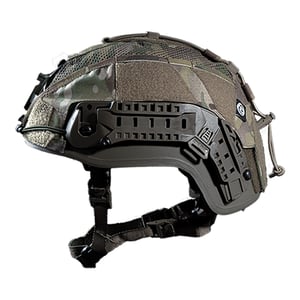
The space around your ears is where coverage and headset fit can compete. A full-cut shell extends lower around the ears. A high-cut shell leaves more room for headsets, with less ballistic coverage at the sides.
Mid-cut models sit between those options. The right choice depends on the coverage you need and how the actual headset fits under the shell. Bring it to the fitting.
Try your eye protection at the same time. Add a respirator or cold-weather headwear if you use them on the job. A headset cup pushed out of place can affect its seal; a crowded setup can also create pressure points.
Mounting hardware needs a closer look, too. Confirm that the shroud, rails, and adapters work with the exact lights, cameras, or night vision you plan to use. A rail alone doesn't prove that every attachment fits.
Use accessories approved for that helmet. Look for blocked side vision and snag points once everything is mounted. Don't drill the shell or alter the mounts without the helmet maker's approval.
Compare the Weight You'll Actually Wear
A shell-only weight won't tell you how much you'll carry. Ask for the weight of the complete helmet, including pads, straps, rails, and mounts, then account for your own gear.
Night vision adds load at the front. A battery pack or counterweight changes the balance, but it also adds weight. Include both when comparing options.
During a safe equipment trial, wear the full setup while turning, bending, and getting in and out of a vehicle. Notice whether the helmet pulls forward or needs repeated adjustment. That trial tells you more about usable comfort than a weight figure alone.
Know What It Takes to Keep the Helmet in Service
Before buying, price approved replacement pads, straps, and hardware and ask how long they take to arrive. A worn strap is easier to address when the right spare is already on hand.
Assign someone to track inspections and damage. Look for cracks, dents, soft spots, separating shell layers, loose mounts, corrosion, torn straps, and crushed or missing pads.
Cleaning and storage rules matter as much as the inspection schedule. Follow the manufacturer's limits for heat, sunlight, moisture, and chemicals. The shell and its replaceable parts may have different service lives and warranties.
After a ballistic hit or a major impact, take the helmet out of service and follow the maker's guidance. Damage may not be obvious from the outside.
Contact Kontek Industries
Kontek Industries offers Busch PROtective helmet solutions. Bring the threats you need to address, a list of your current gear, and any fit problems you've had with previous helmets.
With over 40 years of experience, Busch PROtective continuously innovates, pushing the boundaries of research and development to exceed industry standards.
Their helmets, including tactical, anti-riot, patrol, and rescue models, are trusted worldwide, having received the distinguished DEA-FBI Ballistic Helmet Protocol certification in 2019. Trusted by law enforcement agencies like the FBI, DEA, USMS, ATF, and SWAT teams globally, Busch PROtective helmets are relied upon by officers everywhere for their exceptional quality and performance.
Contact Kontek Industries to discuss ballistic helmet options for your team.