
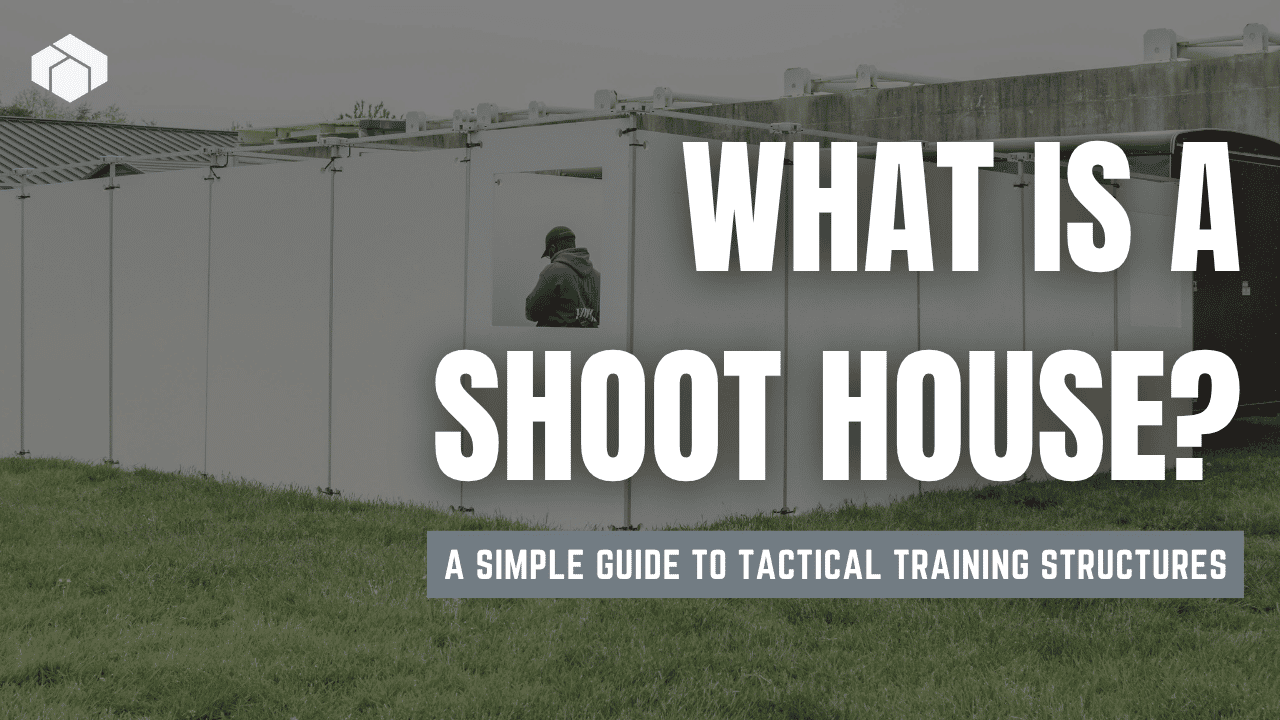
A shoot house gives training a structure. It gives military, law enforcement, and security teams a controlled place to practice close-quarters movement , decision-making, communication, and scenario response.
If you need to train for building entries, room clearing, hallway movement, or threat identification, a shoot house helps turn those situations into repeatable training events.
Here is a deep dive into what defines a shoot house and its purpose for tactical training.
What Is a Shoot House?
A shoot house is a training structure designed to simulate real buildings, rooms, hallways, doorways, and interior spaces used in tactical operations. These structures help teams practice close-quarters battle, also known as CQB, in an environment that feels more realistic than an open range.
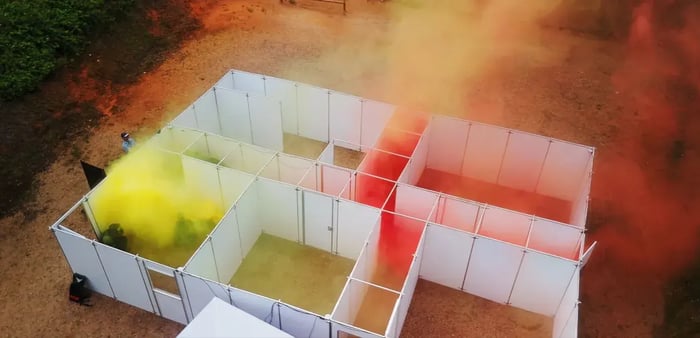
Some shoot houses are permanent buildings. Others are modular systems that can be moved, changed, or rebuilt into different layouts. The exact setup depends on the team, the training goals, and the level of realism required.
What Is the Purpose of a Shoot House?
The purpose is to help teams train for the type of movement that happens inside buildings. Instead of standing on a flat range and shooting at static targets, trainees can move through rooms, communicate with teammates, identify threats, and respond to changing scenarios.
Teams can practice:
- Room clearing
- Hallway movement
- Doorway entries
- Communication under stress
- Target identification
- Team coordination
- Use of cover and concealment
- Scenario-based decision-making
- Low-light or limited-visibility movement
- K9 training
- Force-on-force exercises
This type of training is important because real operations rarely happen in open, predictable spaces. They often happen inside buildings with corners, tight rooms, blind spots, furniture, unknown occupants, and limited visibility.
Why Shoot House Training Matters
Shoot house training helps teams build habits that are hard to develop in an open training area.
Inside the structure, trainees have to think while they move. They need to watch their muzzle direction, read the room, stay aware of teammates, and avoid rushing through the structure just because they know a target might be ahead.
That is one of the biggest values of this type of training. It teaches you to slow down when you need control and speed up when the scenario demands action.
It also exposes weak points fast. Poor communication shows up. Bad spacing shows up. Unclear entry plans show up. A layout that looked simple during a briefing can feel completely different once a team is inside it.
Some of the key benefits include:
- Realistic structure-based training: Teams can practice inside layouts with rooms, hallways, doors, corners, and blind spots instead of training only on a flat range.
- Improved communication: Teams can practice callouts, movement commands, role assignments, and coordination while moving through tight spaces.
- Repeatable training scenarios: Instructors can run the same drill multiple times, adjust details, and help teams improve through repetition.
- Better instructor control: Instructors can design specific problems, observe team performance, and reset scenarios for the next run.
Common Types of Shoot Houses
Shoot houses come in several forms. The right option depends on how often a team trains, where they train, and what kind of scenarios they need to run.
Permanent Shoot Houses
A permanent shoot house is a fixed structure built in one location. These are often used at military bases, large law enforcement training centers, or dedicated tactical facilities.
They can be strong, realistic, and built around a specific training program.
The tradeoff is flexibility. Once the structure is built, changing the layout can be difficult or expensive. Teams may also become too familiar with the same rooms, hallways, and entry points if the layout never changes.
Modular Shoot Houses
Modular shoot houses are built with sections or panels that can be moved, connected, and rearranged. This gives instructors more flexibility when creating training scenarios.
One layout might focus on basic room clearing. Another might use longer hallways, multiple entry points, or more complex room connections. That layout variety is a major advantage.
It keeps training from turning into a memory exercise. Instead of learning one building, teams have to rely on communication, movement, and decision-making.
These systems can also be set up, taken down, relocated, and stored more easily than permanent structures. That makes them useful for agencies, instructors, and training facilities that do not want to commit to one fixed building.
Live-Fire vs. Non-Live-Fire Shoot Houses
One of the most important differences between shoot houses is whether they are built for live-fire or non-live-fire training.
A live-fire shoot house is designed to handle real ammunition. That requires serious planning around ballistic containment, materials, safety zones, range rules, ventilation, and instructor control.
A non-live-fire shoot house is used for training methods like dry-fire, marking rounds, simunitions, UTM, airsoft, and scenario-based exercises.
Non-live-fire systems are often easier to reconfigure and more practical for frequent training. They let teams work on movement, communication, decision-making, and tactics without needing a full live-fire facility.
Who Uses Shoot Houses?
Shoot houses are mostly used by teams that need to train for close-quarters environments.
That includes:
- Military units
- Law enforcement agencies
- SWAT teams
- Tactical instructors
- Security teams
- Training academies
- K9 units
- Private security organizations
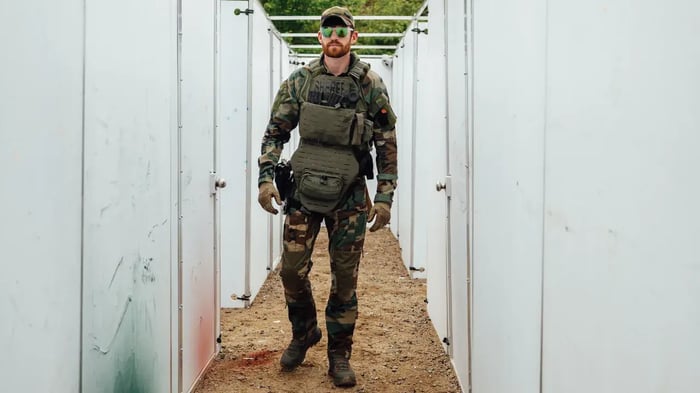
For firefighters, similar modular structures can support fire and rescue modular training to practice search drills, hose line movement, V.E.S. training, victim removals, and rescue operations.
Shoot houses have also entered the school safety conversation. In Ohio, officials moved to purchase modular shoot houses to train armed teachers and school personnel for active shooter response scenarios.
The training need may vary, but the core problem is usually the same. Teams need a controlled place to practice movement through structures before they have to do it in a real operation.
What to Consider Before Choosing a Shoot House
Before choosing a shoot house, start with the training mission.
Do you need a permanent structure or something portable? Will the system be used indoors, outdoors, or both? How many people will train at once? Do you need simple room clearing layouts, more complex CQB scenarios, K9 training, or force-on-force exercises?
Those answers matter more than picking the biggest or most expensive option.
Key questions to ask include:
- How much space is available?
- How often will the shoot house be used?
- Does the layout need to change often?
- How fast does setup need to be?
- Will the system be stored between training sessions?
- What type of training rounds or methods will be used?
- How many trainees need to move through at once?
- Can instructors safely observe and control the scenario?
- Will the structure support future training needs?
A shoot house should fit the way your team actually trains. If the system is too rigid, too hard to move, or too slow to reconfigure, it may limit the training instead of supporting it.
Contact Kontek Industries
Kontek’s Mobile Modular Shoot House is designed for portable, non-live-fire tactical training. It can be reconfigured for CQB, K9 training, scenario-based drills, and team movement exercises.
Contact Kontek Industries today to learn more about Mobile Modular Shoot House options for your training program.